 Sage.Education
The Uninvited Guest
Part 1 of 3. A companion to "The Walled Garden."
On May 5, 2026, Alexander Hanff opened the file browser on his Mac and looked at what Chrome had been doing while he was not watching. Hanff is a computer scientist and privacy researcher who writes under the name "That Privacy Guy." He has spent two decades studying how software moves data around without asking. He knows where and what to look for.
Inside his Chrome profile directory sat a file called weights.bin, sitting inside a directory Chrome had created called OptGuideOnDeviceModel. The file was 4 gigabytes. He had not downloaded it. He had not been asked whether he wanted it. No dialog box had appeared. No notification had arrived in any inbox or system tray. Google Chrome, acting through a subsystem called the component updater, had reached silently into his personal machine and written a large language model[1] to his hard drive without his permission.[2]
The file contained the weights[3] for Gemini Nano,[4] Google's on-device AI. Hanff deleted it. Chrome downloaded it again.
He went into Chrome's settings to find a toggle, a checkbox, a preference, anything that would let him prevent the download. There was nothing. The only reliable mechanism to stop the installation permanently was an enterprise group policy, a tool designed for IT administrators managing corporate fleets of thousands of machines, not for a single person trying to control what lives on a computer they own.[5]
Hanff did not write an angry tweet; he wrote a legal analysis. The EU's ePrivacy Directive, Article 5(3), requires prior informed consent before storing information on a user's device. Exceptions are narrow: storage is permitted only when it is "strictly necessary" to provide a service the user explicitly requested.[6] A 4 GB AI model that powers features forcibly on by default, features the user never asked for, installed without notification, re-installed after deletion, with no opt-out found in settings, is difficult to characterize as strictly necessary for web browsing.
His findings went live that morning. Within hours, the story had reached gHacks, Tom's Hardware, Neowin, CyberNews, and the front page of Hacker News.[7] The backlash was immediate and loud.
But the backlash was about the wrong thing: the internet argued about disk space and bandwidth. The story we feel matters is the 38 million Chromebooks sitting in the backpacks of schoolchildren, and what just arrived on every one of them.
Thirty-Eight Million Backpacks
The numbers tell the rest of the story. Chromebooks account for 60.1 percent of the global K-12 device market.[8] Thirty-eight million units sit in classrooms across six continents. Ninety-three percent of U.S. school districts plan to purchase more this year.[9] The average education-sector Chromebook now stays in service for 8.1 years, nearly double the lifespan of four years ago.[10]
Every one of them runs Chrome. Chrome's component updater does not distinguish between a security researcher's workstation in Ireland and a nine-year-old's Chromebook in Lower Merion, Pennsylvania. Between April 20 and 29, the same 4 GB download rolled out to all of them through the same channel that delivers security patches.[11]

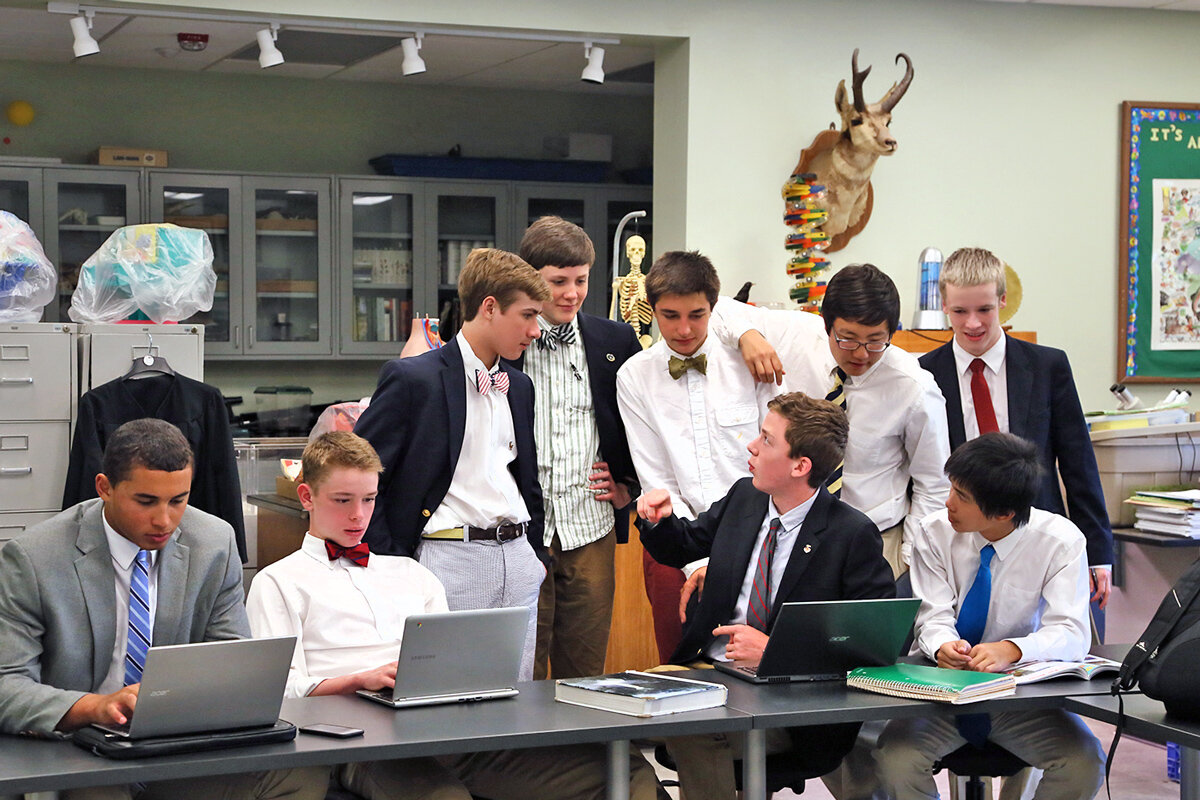
A school hallway. Thirty-eight million Chromebooks sit in classrooms like this one. Between April 20 and 29, every one of them received an uninvited guest. Photo: CC BY-SA 4.0, via Wikimedia Commons.
No superintendent received an advisory. No school board voted. No IT director was consulted. No parent was told.
Lower Merion is worth pausing on. In March 2026, more than 200 parents in the suburban Philadelphia district signed a petition asking to opt their children out of the one-to-one Chromebook program entirely. Their concerns were specific: no content filters, students using AI for assignments, the impossibility of teachers policing device use. Superintendent Frank Ranelli initially told parents that opting out was "not possible" because the curriculum required electronic devices. By May, under sustained pressure, the district announced it would "review the need to assign individual devices" to its youngest students.[12]
Those parents were fighting about whether their children should carry Chromebooks at all. While they argued, Google installed an AI model on every Chromebook in the district. Nobody in the argument noticed, because nobody was notified.
The parents who spent months fighting for the right to say no to a Chromebook did not know that Google had spent ten days installing AI on every Chromebook that had already been said yes to.
The Component Updater
The mechanism matters. Chrome does not install Gemini Nano through a browser update that appears in the "About Chrome" dialog. It installs through the component updater, a separate subsystem that downloads and installs modular components independently of the browser version. Component updates are silent by design. They do not trigger restart prompts. They do not appear in update logs accessible to non-technical users. They are the plumbing behind Chrome's ability to push changes without the friction of a full browser update.[13]
The component updater is how Chrome delivers certificate revocation lists,[14] which are security-critical. It is how Chrome delivers its built-in PDF viewer. It is also, now, how Chrome delivers a 4 GB AI model that the user did not request and cannot easily remove.
The architecture creates a bundling problem that schools cannot solve without specialized knowledge. Disabling the component updater to prevent the AI download would also prevent security patches. For a school district managing thousands of devices, this is not a choice. It is a hostage negotiation dressed as a feature.

Lockers in a school hallway. Behind them, a network of managed devices that a company in Mountain View can modify without asking. Photo: Public domain, via Wikimedia Commons.
ConductAtlas, a compliance research firm, analyzed Chrome's Terms of Service in the days after Hanff's disclosure. Their finding: Chrome's terms authorize automatic software updates to the browser, but "four gigabytes of AI model weights that power features the user never requested is a different category, and the terms do not explicitly address it."[15] The user who accepted Chrome's Terms of Service in 2019 has now consented, retroactively, to a technology that did not exist when they clicked "I agree."
Hanff knew Chrome would re-download the file overnight. He published the filesystem logs, the legal analysis, and the regulatory implications. Then he closed his laptop and left the uninvited guest sitting on his hard drive, because the architecture gave him no other option.
In Lower Merion, on 38 million Chromebooks worldwide, the guest had already made itself at home. The question of who consented is the subject of Part 2: "The Consent That Was Never Given."
*This article is Part 1 of "The Uninvited Guest" series, a companion to "The Walled Garden," published March 2026. The views expressed are those of the editorial board and do not necessarily reflect the positions of any institution mentioned.
Sage.is AI-UI and Sage.Education are products of Startr LLC; their inclusion represents a disclosure of interest. No individuals quoted in this article were interviewed; all quotes are from published sources. Full disclosure and transparency is a feature, not a bug.
Large language model (LLM) is an AI system trained on vast amounts of text to predict and generate language. LLMs power tools like ChatGPT, Google's Gemini, and Anthropic's Claude. They are typically accessed through internet-connected servers, but smaller versions can run directly on a personal device. ↩︎
Alexander Hanff, "Google Chrome silently installs a 4 GB AI model on your device without consent." That Privacy Guy, May 5, 2026. Hanff is a computer scientist and privacy researcher who previously documented ePrivacy violations by Anthropic's Claude Desktop installer. thatprivacyguy.com. ↩︎
Model weights are the numerical values an AI has learned during training. They are what make the model "know" things. A weights file is essentially the AI's brain stored as data on disk. At 4 GB, Gemini Nano's weights file is roughly the size of a full-length HD movie. ↩︎
Gemini Nano is Google's smallest version of its Gemini AI, designed to run directly on a user's device rather than on Google's cloud servers. It powers features like text composition assistance and scam detection in Chrome. Unlike cloud-based AI, it processes data locally, but it must first be downloaded and installed on the device. ↩︎
Enterprise group policy is a management tool that allows IT administrators to enforce settings across all devices in an organization from a central console. In the Chrome context, it is the only way to permanently prevent the Gemini Nano download. Individual users without enterprise tooling have no equivalent control. Make Tech Easier. ↩︎
ePrivacy Directive: Directive 2002/58/EC of the European Parliament, Article 5(3). Requires prior informed consent before storing information on a user's terminal equipment, with exceptions only for storage "strictly necessary" to provide a service the user explicitly requested. The Directive applies across all EU member states and forms part of the legal basis for GDPR enforcement. byteiota legal analysis. ↩︎
Coverage of Hanff's disclosure: gHacks Tech News, Tom's Hardware, Neowin, CyberNews, Hacker News discussion. ↩︎
Education Sector Chromebook Adoption Statistics 2026. About Chromebooks. ↩︎
CoSN (Consortium for School Networking), "2025-2026 K-12 IT Leadership Survey." Chromebook procurement data. cosn.org. ↩︎
Education-sector Chromebook average lifespan: 8.1 years in 2026, up from approximately 4 years pre-2024. About Chromebooks. ↩︎
Component updater: Chrome's modular update subsystem, separate from the browser version update mechanism. Component updates are delivered silently, do not trigger restart prompts, and do not appear in the "About Chrome" dialog. They share the same update channel as security-critical components such as certificate revocation lists. ConductAtlas analysis. ↩︎
Lower Merion Township School District, Pennsylvania. More than 200 parents signed a petition to opt out of the one-to-one Chromebook program. Superintendent Frank Ranelli initially said opt-out was "not possible." By May 2026, the district announced a review of device assignment for youngest students. Philadelphia Inquirer. 6abc Philadelphia. ↩︎
Technical details of Chrome's component updater architecture. Component updates install to per-profile directories, including
OptGuideOnDeviceModelfor Gemini Nano weights. Deletion triggers re-download on next component update cycle. AskVG technical walkthrough. Users can inspect the installation viachrome://on-device-internals. ↩︎Certificate revocation lists are security files that tell a browser which website security certificates have been revoked or are no longer trustworthy. They are critical for preventing users from connecting to compromised or fraudulent websites. Chrome delivers them through the same silent component updater that now also delivers Gemini Nano. ↩︎
ConductAtlas, "Chrome Downloaded 4GB of AI to Your Machine. Here Is What Google's Own Policies Say About It." May 2026. ConductAtlas is a compliance research firm specializing in platform governance analysis. conductatlas.com. ↩︎