 Sage.Education

On a quiet street in Westmount, Montreal, there is a school where Grade 8 students wire their own lighting systems, kindergartners learn to code, and a team of teenage girls recently built an AI tool that spots when a photo gives away more about the person who posted it than they meant to share. The school is called The Study,[1] an all-girls' school founded in 1915. It has about 400 students. And it is the only K-12 school in Canada to have built and launched its own private AI platform.[2]
The AI's name is Rosie, after both the robot from The Jetsons and Rosie the Riveter – the wartime icon of women doing work the world said was not for them. Rosie runs on campus, on the school's own hardware, and no student data needs to leave the building. But Rosie is not the story. The story is what happened next: teachers and students started building their own AI agents and tools alongside her.
Nobody in government expected this from teenage girls and AI.
The Wrong Question
Across Canada, politicians are pushing to ban AI chatbots for anyone under sixteen.[3] Manitoba wants to be the first province to enforce it.[4] A May 2026 poll found that more than two-thirds of Canadians support the idea.[5]
The worry makes sense. The solution does not.
Michael Geist, a University of Ottawa law professor and one of Canada's leading voices on digital policy, called the push "the illusion of protection." A ban, he argued, would push young people toward offshore AI tools with no safety filters and no content rules.[6] Meanwhile, 73 percent of Canadian students are already using AI for schoolwork.[7] Banning it has not worked. Some teachers now say that ignoring AI is more dangerous than using it.[8]
The question most schools are asking is whether AI should be allowed in.
The Study stopped asking that question eighteen months ago.
The question it asks instead is: whose AI, on whose terms, in whose hands.
The answer The Study came to was not bold or radical. It was the next step in something the school had been doing for decades.
From Information to Imagination
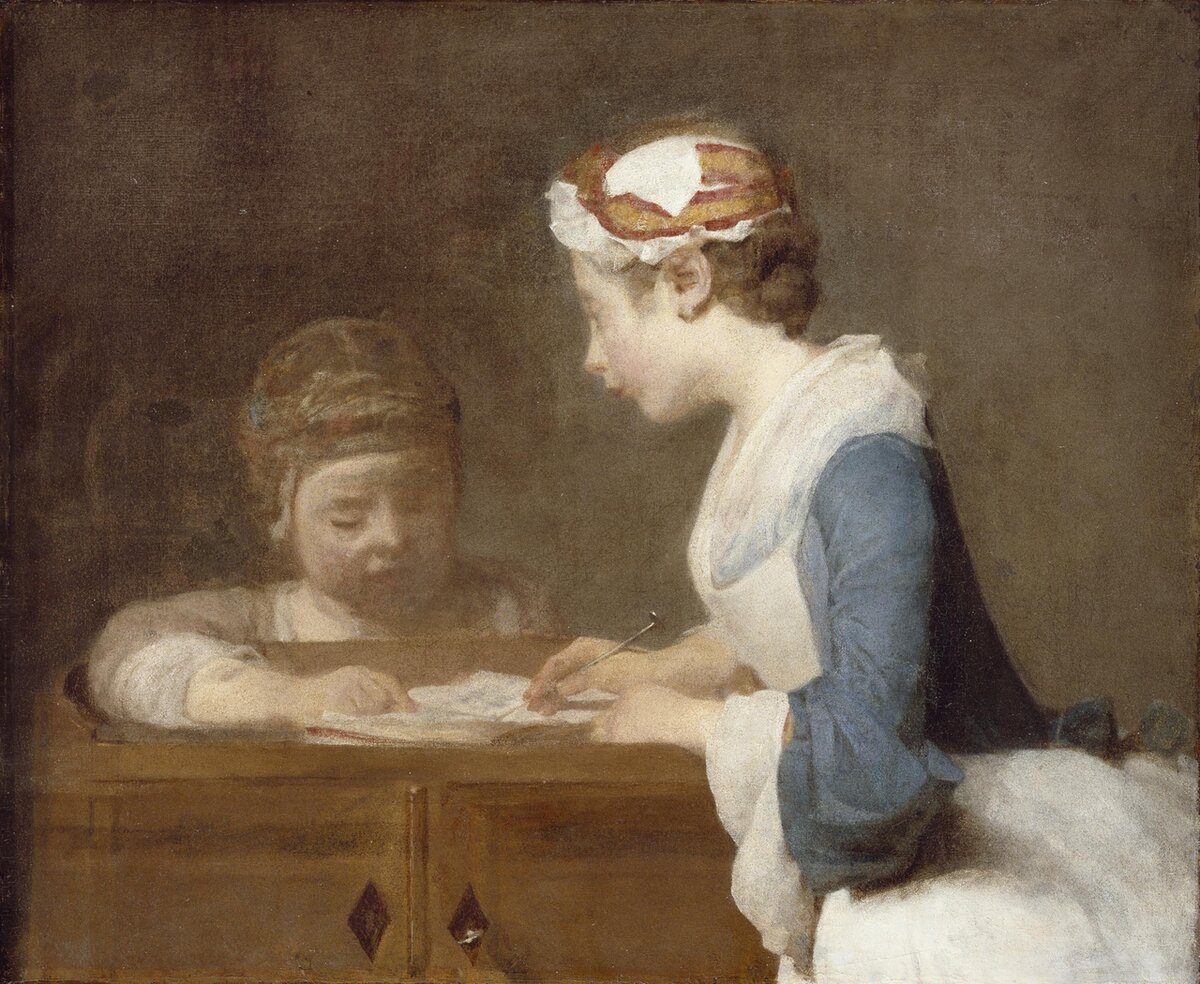
Jean-Baptiste-Siméon Chardin, "The Schoolmistress" (c. 1735). National Gallery, London. One teaches, the other learns. The tools are simple. The method is what matters. Public domain
The schools most of us grew up in were built for the Information Age. Their job was to get students close to knowledge – books, data, experts. That job is done. Information is now everywhere, instant, and free. What matters now is not finding information. It is knowing what to do with it – the ability to look at everything available and make something new.
The Study has been practising this for longer than most schools have been talking about it.
The school's own AI Framework describes decades of hands-on learning.[9] It was the first school in Quebec to give every student a laptop. Coding starts in kindergarten. Robotics begins in Grade 4. From K through 11, students learn by doing: they test ideas, try things, fail, and try again. The school's stated goal is that "students should engage with technology as creators rather than passive consumers."
That goal existed long before AI showed up. Students at The Study have built working go-karts. They have created startup prototypes that won national and international awards. They have wired their own lighting systems. They have presented research at the United Nations. They have designed their own digital games. They have even run their own code on the International Space Station.
When AI arrived, it did not change the school's direction. It walked into a building that was already ready for it.
When ChatGPT launched in November 2022, Amalia Liogas, The Study's Director of IT, went to the head of school with a blunt message: "Shame on us if we don't teach these girls how to control and use AI." By the following September, Rosie was live. "It's not innovation for innovation's sake," Ms. Liogas said. "It's innovation for the betterment of education."
Meet Rosie
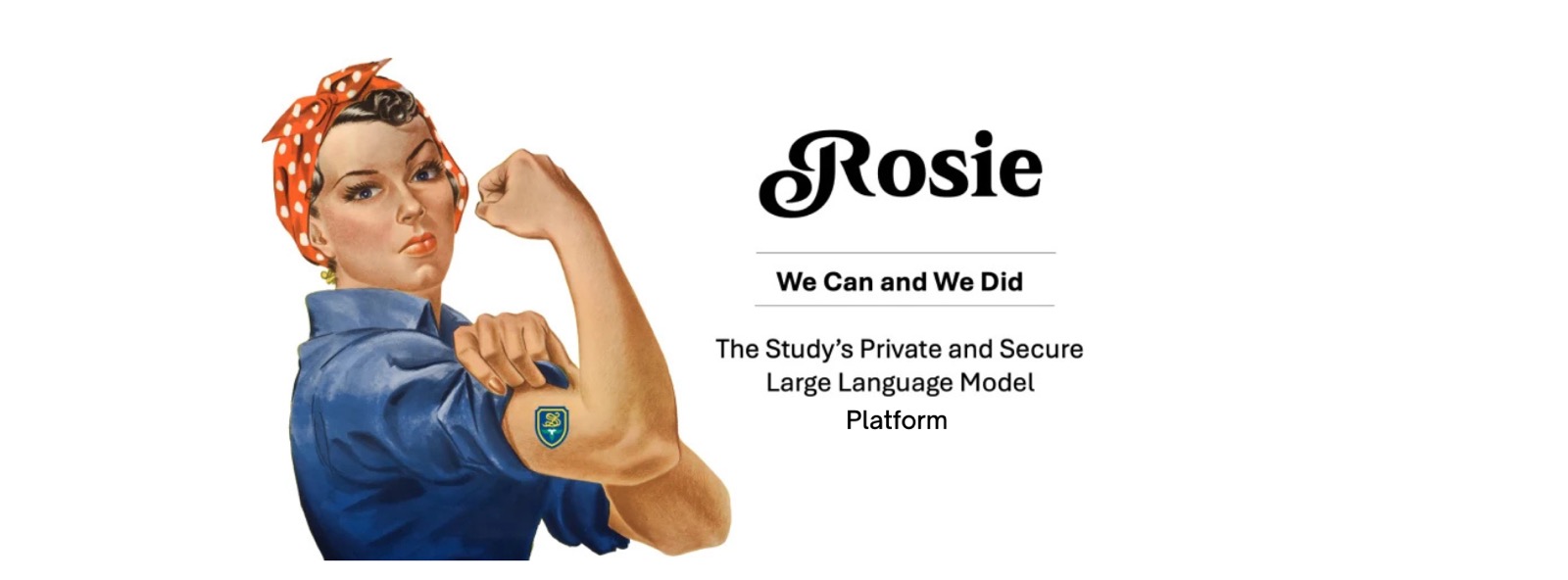
The Rosie platform – The Study's private AI agent, running on campus infrastructure. Photo courtesy of The Study.
The name was chosen with care. Rosie is named after two icons: the robot from The Jetsons, who was part of the household rather than a replacement for it, and Rosie the Riveter, the image of a woman rolling up her sleeves to do the work. At an all-girls' school, the name carries weight.
Four things matter about Rosie.
Rosie runs on-site. Student data stays on campus. Nothing needs to leave the building. Most school AI tools send student data to outside servers, sometimes in other countries. At The Study, the school owns and controls the AI.
Teachers decide what Rosie does. She is not a black box. The school sets the rules, the guardrails, and how she grows over time.
Because the school owns the base layer, it does not have to say no to every new tool. It can say yes – because the floor is solid.
Rosie is not the end product. She is the starting point. Teachers and students build their own AI tools on top of her – solving problems they find themselves. The difference is between giving a student a calculator and giving them a workshop.
For parents who are not technical, the description is simple. "We created Rosie as a walled garden," Ms. Liogas said. "It was a way for kids to learn how to use AI without fear of releasing private information." For the youngest students, Rosie is the only AI they use. "We don't sell young child information online," Amalia Liogas said. "That happens too often, and I wasn't going to be part of that."
Being the only K-12 school in Canada to build its own local AI platform is not a departure from what The Study has always done. It is the latest version of the same idea: own the tools, and free the people who use them. "All of Rosie is sitting on our own server," Ms. Liogas said. "I can walk over and shut it off. Any data in there is under our control. Data safety was our number one concern."
What the Girls Built
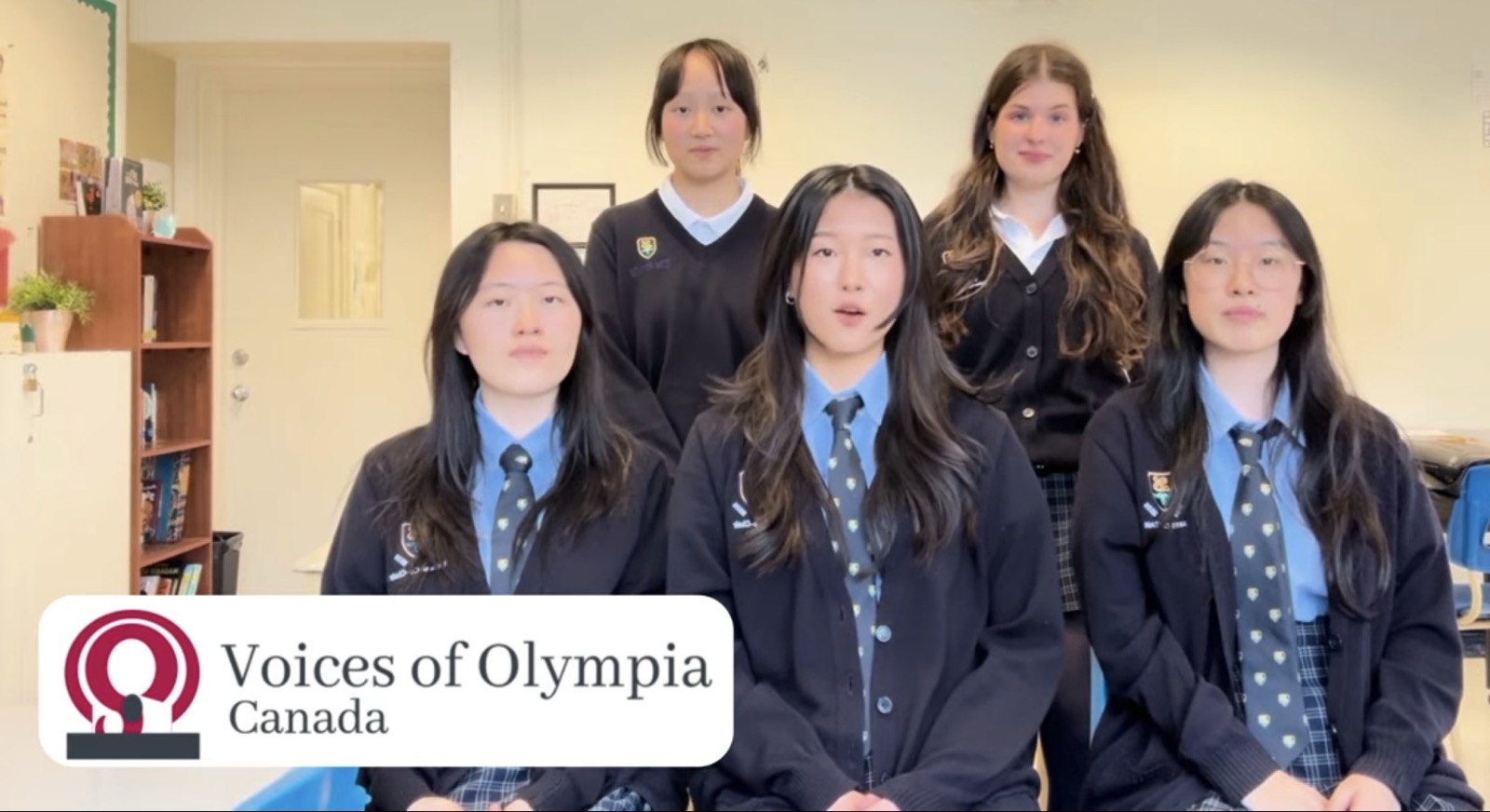
The SafeTrace team at The Study. Photo courtesy of The Study.
On May 4, 2026, Ms. Liogas and a team of students stood in front of a room of IT directors and education leads at an Apple event. They were not there to talk about using AI. They were there to talk about building with it.
CTV had covered The Study's AI work a few weeks earlier.[10] After the presentation, two private schools asked to see Rosie. A McGill University professor reached out about teaching vibe coding. The interest was not in the technology. It was in the attitude: an all-girls' school that treats its students as builders.
The star of the presentation was SafeTrace, an AI tool that spots self-doxxing in photos. Upload a picture – the kind a teenager might post to social media – and SafeTrace finds what you accidentally gave away. A school crest on a blazer. A street sign in a window reflection. GPS data hidden in the file. Built by students, for students, to solve a problem that girls face more than most.
The team behind SafeTrace, Ashley Guan, April Sang Jia, Atenea Putterman, Xinyi Zhang, and Yixin Zhao, studied cybersecurity and online gender-based violence, supervised by Ms. Liogas and their mentor, Ms. Mathieu.[11] They won first place at the Olympes de la Parole Canada, took the VOOC First Prize of Excellence, and received honours for Best Essay, Most Innovative Project, and Exceptional Dedication.[12]
The idea did not come from a textbook. The team talked to Shields of Athena,[13] a Montreal shelter for women facing violence, and learned firsthand about the dangers of accidentally revealing your location online. "They told us about a lot of problems that women go through," one student said. "So we wanted to develop this app based on some of their ideas as well."
Other students at The Study build with models running on Rosie, creating their own AI tools. The school provides the platform and the method. The students bring their imagination.
Asked what it feels like to build on top of AI rather than just use it, one student thought for a moment. "It's not really all about the code," she said, "but about the iteration process. Building with AI is more of a communication process." Another put it more simply: "It's really amazing how fast and how far we've come with AI to build things."
When told that some schools and provinces want to ban AI for students under sixteen, the girls were direct. "By banning it, schools are actually preventing students from learning how to properly use AI, and that's making the problem even more serious," one said. "The important thing should be to teach students how to use AI properly and responsibly instead of just saying 'don't use AI.' Because as society evolves, it's going to continue being a greater part of our daily lives."
Asked what they would build next if no one stopped them, they did not aim for the moon. Their first goal is to make SafeTrace better: "to make it more accessible to people." They have signed a contract among themselves to keep working on it and all five are heading to the same school next year. One wants to study aerospace engineering and sees AI as a way to "help us do our research and perfect our models." Another summed it up for all of them: "We really only scratched the surface with AI. I think it would be really interesting to dive deeper – to learn how to train models and build agents." A select few students will be learning how to do this as junior interns this coming summer with Sage.Education, the developers of Rosie's AI engine.
What Stays

Judith Leyster, "Self-Portrait" (c. 1630). National Gallery of Art, Washington. She chose her own brush, her own canvas, her own subject. The girls at The Study are doing the same thing with different tools. CC0
Last year's class built great things on Rosie – and then graduated. That is how schools work. Projects do not carry over the way they do in a company. What carries over is the habit.
In the senior grades, students pick their own tools – Lovable, Claude Code, OpenAI Codex, Rosie – and the school does not choose for them. "Because when they leave The Study, there's going to be no one dictating to them," Ms. Liogas said. "They have to understand why to choose what, and for what reason. If you haven't tested it, you don't know."
The shift has been clear. "We've left the age of information and are entering the age of imagination," she said. Students brought ideas to life fast enough that they could then reach out to community groups, apply for funding, and chase grants. "We never had the time before to do any of this." And the technical learning did not disappear – students still learned version control through Git, still learned to deploy to servers. "They're learning different technology," Amalia Liogas said. "Not less."
42
There is a number on The Study's IT director's project site – 42. It comes from The Hitchhiker's Guide to the Galaxy: 42 is the answer to life, the universe, and everything. The joke is that no one ever figured out the question.
The Information Age was the same. A century spent gathering answers – the tools, the models, the systems. We have them now. The question is what we will imagine with them.
The people most likely to find that question are the students in classrooms right now. Building things nobody asked for, with tools nobody chose for them. They have been doing this at The Study for decades. The only thing that changed is the power of the tools.
Don't panic. They already started.
About Sage.Education
Rosie runs on Sage.is AI UI, the platform that powers Sage.Education and Sage.is, a Canadian AI platform that lets schools and small businesses run their own AI on their own hardware. The Study already believed in ownership, transparency, and student freedom. Sage.is AI UI was the platform that matched those values.
Footnotes
Disclosure: Rosie runs on infrastructure built by Sage.is. This article is part of the Sage.Education series. The editorial decisions, reporting, and final prose are the author's. Quotes from Amalia Liogas and students at The Study were captured in a May 2026 interview and used with permission.
The Study, an independent bilingual all-girls' school in Westmount, Montreal, founded in 1915. thestudy.qc.ca ↩︎
The Study launches Rosie, a private large language model to enhance student learning. The Study ↩︎
Canadian federal Liberals voted at their April 2026 policy convention to back a minimum age of 16 for social media accounts and AI chatbots. Culture Minister Marc Miller said the government was "seriously" considering a ban or moratorium. Bloomberg ↩︎
Manitoba announced it would be the first Canadian jurisdiction to ban youth under 16 from using social media and AI chatbots, starting in schools. CBC News ↩︎
More than two-thirds of Canadians support banning access to social media and AI chatbots for children under 16. May 2026 poll. National Observer ↩︎
Michael Geist, University of Ottawa law professor. "The Illusion of Protection: Why Canada's Growing Push to Ban Social Media for Kids Won't Work," April 2026. michaelgeist.ca See also: "Government Has a Choice: Why an AI Chatbot Ban for Kids is an Even Worse Idea Than a Social Media Ban," May 2026. michaelgeist.ca ↩︎
KPMG survey, October 2025. 73% of Canadian students rely on generative AI for schoolwork, up from 52% two years earlier. KPMG Canada ↩︎
"How Canada's AI patchwork is failing students in the classroom," Policy Options (IRPP), January 2026. policyoptions.irpp.org ↩︎
The Study, AI School Framework (internal document, shared by Amalia Liogas, Director of IT). thestudy.qc.ca ↩︎
SafeTrace presentation by Ashley Guan, April Sang Jia, Atenea Putterman, Xinyi Zhang, and Yixin Zhao. YouTube ↩︎
Olympes de la Parole Canada, 2025–2026 edition. The SafeTrace team won 1st place, the VOOC First Prize of Excellence, and was honoured with a Jury Mention for Best Essay, Most Innovative Project, and a Jury Commendation for Exceptional Dedication to the VOOC School Competition. LinkedIn | olympesdelaparolecanada.ca ↩︎
Shields of Athena Family Services – providing services to victims and those at risk of family violence and human trafficking. shieldsofathena.com ↩︎