 Sage.Education
The Builders You'd Ban
When Age Gates Meet the Generation That Already Builds With AI
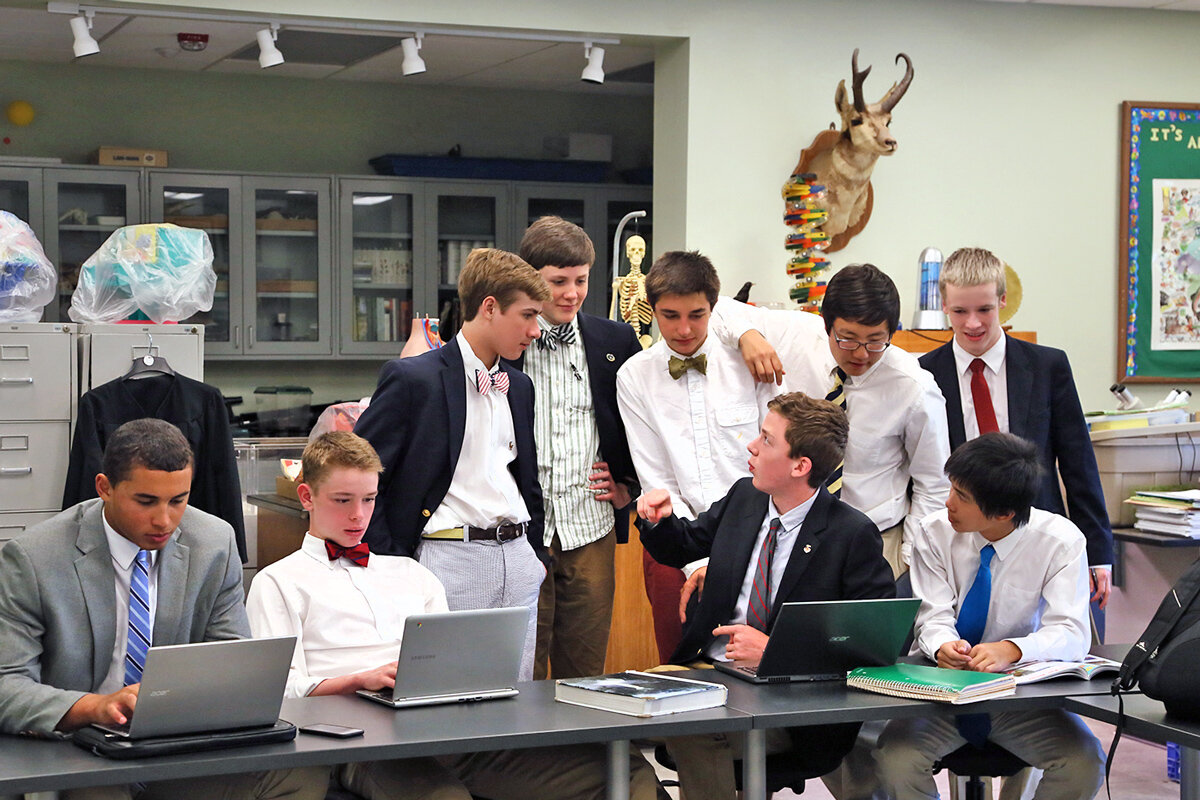
Five students at The Study, an all-girls private school in Westmount, Montreal, built an app called SafeTrace.[1] It scans photos for personal information before you post them online. The kind of information a teenager might not notice: a school crest on a uniform, a street sign in the background, a reflection in a window that reveals a location. Built by students, for students, to solve a problem that girls face more than most.
They used AI tools to build it. They chose which tools to use. They learned on infrastructure their school controls.[2]
Under the ban that Canada's Senate is studying, these students might not be allowed to use most of the tools they used to build SafeTrace. The Liberal Party voted in April 2026 to restrict AI chatbot access for anyone under 16.[3] Manitoba is moving to ban them provincially.[4] The federal government says it is "very seriously" considering the idea.[5]
The debate treats young people as passive consumers of dangerous technology. It does not account for the ones who are already building with it.
The Founders
The students at The Study are not an exception. They are part of a generation that is building with AI at a pace no previous generation could match.
Alby Churven is 14 years old and lives in Sydney, Australia. He started building AI startups after a video he made about Y Combinator went viral on social media.[6] He is not old enough to drive. Under the ban, he would not be old enough to use ChatGPT.
Nick Dobroshinsky is 15. His company, BeyondSPX, uses AI to generate stock analysis reports. It has 50,000 monthly users.[7]
Pranjali Awasthi founded Delv.AI when she was 16. The company uses artificial intelligence to transform how people do data research.[8]
Raghav Arora co-founded GetASAP at 16. The company now has 48 employees and has raised $3.4 million in funding.[9]
These are not edge cases. AI startups led by founders under 27 collectively raised over $100 million in 2025.[10] Venture capital firms, including Y Combinator, no longer have strict age minimums. The barrier to building real software has dropped so far that a teenager with a laptop and an AI tool can ship a product that competes with teams of adults.
A ban treats these founders as children who need protection from technology. The venture capital market treats them as founders who deserve funding. Both cannot be right.

School lockers. Behind these walls, a generation of builders is using AI to start companies, solve problems, and create tools. A ban would lock them out of the platforms with safety features and push them toward the ones without. Photo: Public domain, via Wikimedia Commons.
The Rights
The debate about banning AI for children is also a debate about rights. Canadian law already recognizes that young people are not a single category.
Michael Geist, a professor of law at the University of Ottawa, testified before the Senate Social Affairs Committee on May 6, 2026.[11] He argued that banning AI chatbots for children raises serious constitutional questions. Section 2(b) of the Canadian Charter of Rights and Freedoms[12] protects the right to receive and express ideas. A teenager researching a health condition, learning to code, exploring identity questions, or doing homework with AI assistance is exercising that right.
Geist wrote: "Children are increasingly recognized as rights-bearers under the Charter and under international instruments such as the United Nations Committee on the Rights of the Child's General Comment 25 on children's rights in digital environments, and a wholesale denial of their access to a major source of information and expression is incompatible with that recognition."[13]
General Comment No. 25, adopted by the UN Committee on the Rights of the Child in 2021, explicitly extends children's rights into digital spaces.[14] These include the right to access information, the right to education, the right to participate, and the right to play. A ban on AI chatbots restricts all four.
The UN's "Our Digital World, Our Say" initiative, launched in 2025 by the Office of the High Commissioner for Human Rights, goes further. It asks children directly whether digital tools respect their rights.[15] The premise is that children have standing to participate in decisions about technology that affects them. A ban made without consulting them contradicts that premise.
Canadian law already has a framework for recognizing that young people mature at different rates. It is called the mature minor doctrine.[16] In 2009, the Supreme Court of Canada ruled in A.C. v. Manitoba that a minor below the age of majority can consent to medical treatment if they demonstrate sufficient understanding and maturity. The decision is based on capacity, not birthdate.
Bill C-27, Canada's proposed privacy legislation, extends this principle to data.[17] It states that minors who are capable of understanding the consequences of data collection can provide meaningful consent. Privacy scholars have proposed graduated consent frameworks[18] that adjust obligations as children mature, rather than drawing a single line at age 16.
The legal infrastructure for capacity-based access already exists. A binary age gate on AI chatbots ignores all of it.
The Substitution
The strongest practical argument against a ban comes from Geist's own testimony. A 15-year-old who cannot access ChatGPT does not stop using AI. They find something else.[19]
The "something else" is the problem. Commercial AI platforms like ChatGPT, Claude, and Gemini are working on dedicated trust and safety teams. They have content moderation. They have crisis routing that tries to connect users expressing suicidal thoughts to help. They have age-appropriate design features, however imperfect.
A banned teenager moves to offshore AI services with no safety infrastructure. Or they use a VPN to access the banned platforms anyway. Australia's under-16 social media ban, implemented in late 2025, achieved roughly 70 percent compliance after three months.[20] Banning AI tools would face even steeper challenges, because the same models are embedded in search engines, word processors, and operating systems that no ban can practically reach.
The ban does not remove AI from children's lives. It removes some of the safer AIs from children's lives.
"You have not protected the child. You have pushed them somewhere worse."
– Alexander Somma

An iron gate to a winding path at Vibble, Gotland. Some schools built their own way through. They own the gate. Photo: CC BY-SA 4.0, via Wikimedia Commons.
The Alternative
The choice is not between banning AI and giving children unregulated access. There is a third option.
Geist proposes an AI Transparency Act that forces companies to disclose their safety policies, training data practices, law enforcement reporting standards, and age restrictions.[21] Not a ban. Accountability. Combined with graduated design obligations[22] that match safety features to demonstrated maturity rather than birthdate, and real penalties for violations.
But transparency and regulation address what happens on commercial platforms. They do not help schools that want to control the environment themselves.
Some schools have built that environment. The University of Missouri's Show-Me AI initiative runs on university-owned servers under university rules.[23] The Study in Westmount built Rosie, an AI agent on school-owned infrastructure, powered by Sage.Education's Sage.is AI-UI.[24] Students build on Rosie's foundation using tools they choose. The school decides what runs. The school decides what is visible. The school decides where the data lives.
Sage.Education does not age-gate.[25] It gives schools the tools to make their own decisions about access, visibility, and safety. The school writes the rules. Teachers can see how students use AI through the Learning Visibility Dashboard, and students know the teacher can see. The data stays on the school's hardware. There are no hidden classifiers, no engagement metrics, no advertising pipeline.
This is not a ban, nor is it unregulated access. It is a classroom, where the teacher is in charge, the rules are clear, and the students are builders.
Self-hosting requires technical capacity that many schools lack, and open-source platforms demand maintenance that underfunded IT departments cannot always provide. But the architecture proves that the choice between banning AI and surrendering to Big Tech's design is a false one. Schools can own the tools their students build with.
The students at The Study who built SafeTrace may replace every tool mentioned in this article before they graduate. The platforms will change, the models will evolve, the policy debates will move on to the next technology.
What will not change is their capacity to build. The question is whether we let them, or whether we ban the generation Canada is investing $2 billion to prepare.
This article is a companion to "Loyal to Whom?" which examines the design disloyalty and governance gaps that make AI chatbots dangerous in the first place. The views expressed are those of the editorial board of Sage.is AI-UI and Sage.Education, and do not necessarily reflect the positions of any institution mentioned. Sage.is AI-UI and Sage.Education are products of Startr LLC; their inclusion represents a disclosure of interest. No individuals quoted in this article were interviewed (yet); all quotes are from published sources. Full disclosure and transparency is a feature, not a bug.
CTV News, "Stopping doxxing in its tracks: Westmount students build app to make sharing photos safer." Students at The Study built SafeTrace, an app that scans photos for personal information before posting. CTV News. ↩︎
The Study, Westmount, Montreal. Built a sovereign AI agent ("Rosie") on school-owned infrastructure, powered by Sage.is AI-UI. Students build on Rosie using tools they choose. ↩︎
Liberal Party of Canada national convention, Montreal, April 9-11, 2026. Members voted to restrict AI chatbot access for anyone under 16. The resolution is non-binding. CBC. ↩︎
Manitoba Premier Wab Kinew announced the province will ban children from using social media and AI chatbots. Bloomberg. ↩︎
Marc Miller, Canadian Culture Minister. The government is "very seriously" considering age restrictions. CBC. ↩︎
Alby Churven, 14, Sydney. Building AI startups after his Y Combinator video went viral. Abacus News. ↩︎
Nick Dobroshinsky, 15. BeyondSPX provides AI-powered stock reports to 50,000 monthly users. Business Report. ↩︎
Pranjali Awasthi, 16. Founded Delv.AI, an AI startup focused on data research. WebProNews. ↩︎
Raghav Arora co-founded GetASAP at 16. The company has 48 employees and $3.4 million in funding. WebProNews. ↩︎
AI startups led by founders under 27 collectively raised over $100 million in 2025. WebProNews. ↩︎
Michael Geist, professor of law at the University of Ottawa and Canada Research Chair in Internet and E-commerce Law. Senate testimony, May 6, 2026. michaelgeist.ca. ↩︎
Section 2(b) of the Canadian Charter of Rights and Freedoms protects freedom of expression, including the right to receive and communicate ideas. Courts have interpreted this to cover access to information, which includes digital tools used for research, education, and personal expression. ↩︎
Geist, "Government Has a Choice: Why an AI Chatbot Ban for Kids is an Even Worse Idea Than a Social Media Ban." michaelgeist.ca. ↩︎
UN Convention on the Rights of the Child, General Comment No. 25 (2021): Adopted by the UN Committee on the Rights of the Child. Extends children's rights into digital environments, including rights to access information, education, participation, play, and privacy. OHCHR. ↩︎
UN Office of the High Commissioner for Human Rights, "Our Digital World, Our Say" initiative, 2025. Asks children directly whether digital tools respect their rights and invites their participation in shaping digital policy. OHCHR. ↩︎
Mature minor doctrine is a legal principle recognizing that a person below the age of majority may have the capacity to make certain decisions if they demonstrate sufficient understanding and maturity. It is based on individual capacity, not a fixed age cutoff. ↩︎
A.C. v. Manitoba, 2009 SCC 30. The Supreme Court of Canada recognized that minors can consent to medical treatment based on demonstrated maturity. Bill C-27 extends this principle to data privacy, stating that minors who understand the consequences can provide meaningful consent. ↩︎
Graduated consent frameworks adjust privacy and safety obligations based on a young person's developing capacity, rather than imposing a single age threshold. Privacy scholars and the Office of the Privacy Commissioner of Canada have endorsed this approach. Slaw. ↩︎
Geist's substitution argument: banned teenagers move to offshore services, open-source local models, or VPN-bypassed platforms with no safety features. Commercial platforms (ChatGPT, Claude, Gemini) have trust and safety teams, crisis routing, and content moderation. The ban removes the guardrails. michaelgeist.ca. ↩︎
Australia's under-16 social media ban, implemented late 2025, achieved approximately 70% compliance after three months. Geist cites this as evidence that AI bans would face even steeper enforcement challenges. ↩︎
Geist's proposed AI Transparency Act would require companies to publicly disclose safety policies, training data practices, law enforcement reporting standards, and age restrictions. michaelgeist.ca. ↩︎
Graduated design obligations require different safety features for different age groups and maturity levels, rather than a single ban. A 10-year-old and a 15-year-old have different capacities and different risks. Safety measures should match the user. ↩︎
University of Missouri, "Show-Me AI" initiative, launched September 2025. Chris Kwak, Chief Information Officer, oversaw deployment on university-owned infrastructure. ↩︎
Sage.is AI-UI. AGPL-3 licensed, self-hosted, model-agnostic. "Your conversations never leave your server." Multi-model support, knowledge bases, Community Hub, no tracking scripts. github.com/Sage-is/AI-UI. ↩︎
Sage.Education does not impose age gates. Schools using the platform make their own decisions about access, visibility, and safety features. The Learning Visibility Dashboard provides transparent oversight without hidden surveillance. sage.education. ↩︎