 Sage.Education

On May 28, 2026, two small publishers in Munich, Germany, learned something strange: Google's search engine had been telling people they were criminals.
Not linking to articles that accused them. Not surfacing old lawsuits or bad reviews. Google itself, in its own words, in a blue box at the top of the search results page, was telling anyone who searched for these companies that they ran subscription traps, engaged in dubious business practices, and were connected to known scams.[1]
None of it was true! The claims did not even appear in the search results below the box.
Google's AI had read various web pages, combined fragments from unrelated sources, and written its own summary. The summary was fiction. It was presented as fact. And it sat at the top of the page, above every real result, in a format designed to look like the final answer.
The publishers went to court. The Regional Court of Munich sided with them. The ruling was short and its language was sharp: Google's AI Overviews, the judge wrote, produce "independent, new, and substantive statements." They are not links to someone else's words. They are Google's own.[2]
A court has now said what millions of parents have not yet realized:
The box at the top of Google is not a search result. It is a claim. And the company making that claim gets it wrong millions of times a day.
Then Google said it would appeal.[3]
The 91% Problem
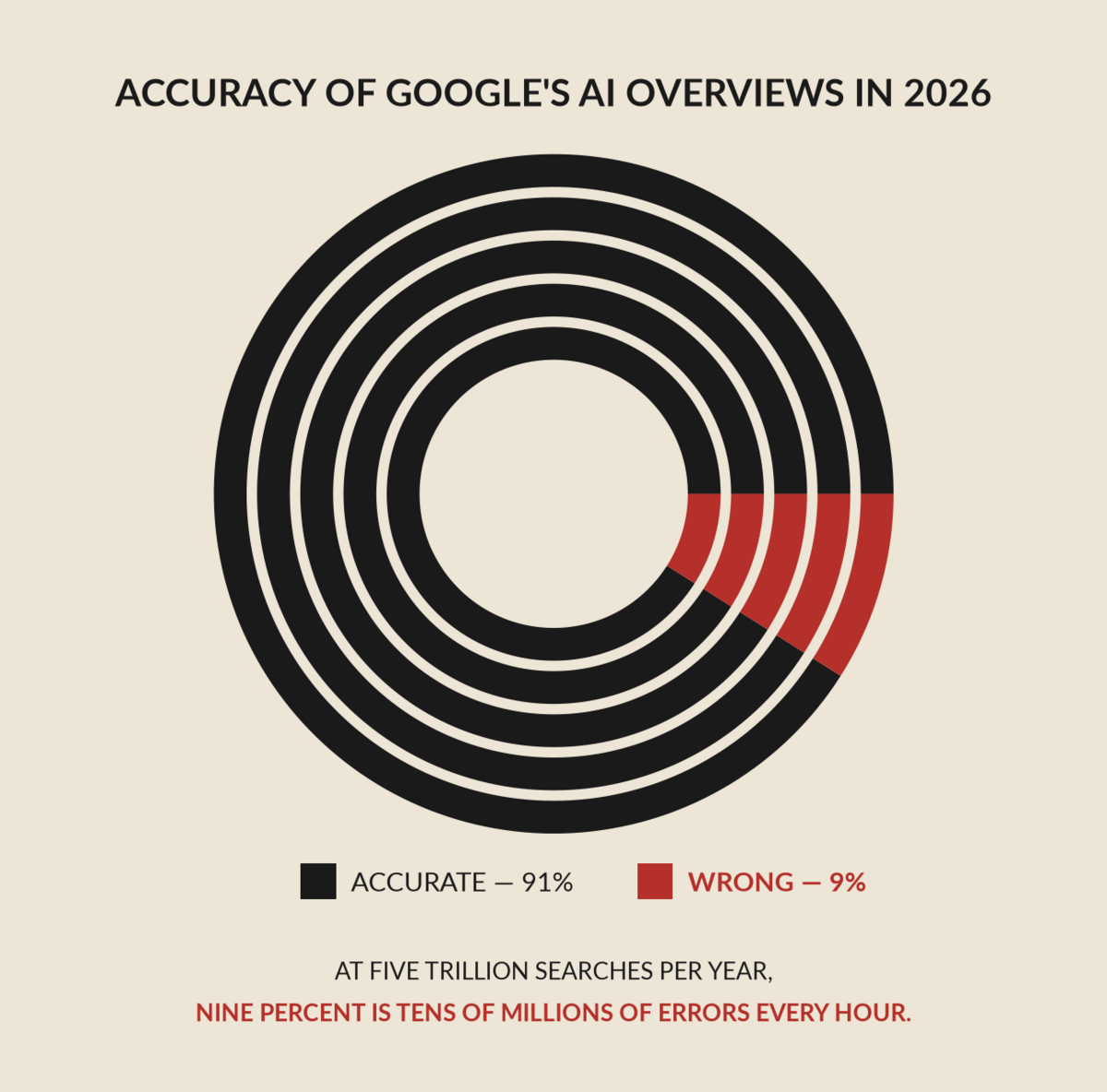
A 9% error rate sounds small. Applied to trillions of searches, it becomes the largest stream of misinformation ever produced by a single company. Illustration: Sage.Education.
Here is a number that sounds reassuring until you do the math. According to an independent study by Oumi, an open-source AI research company, published in April 2026, AI Overviews are accurate about 91% of the time.[4] Ninety-one percent: on a math test, that is an A-minus. You would be proud of your kid.
Now apply it to scale: Google handles more than five trillion searches a year. If AI Overviews appear on even a fraction of those searches, a 9% error rate means tens of millions of wrong answers every single hour. Hundreds of thousands every minute.[5] Not wrong in the way a textbook has a typo on page 312. Wrong in the way that a confident adult tells a child something untrue, and the child believes it, because the adult sounded certain.
These are not projections. The errors are already reaching real people. The Guardian newspaper documented cases in January 2026 where AI Overviews gave dangerous medical advice to patients searching for information about pancreatic cancer and liver disease. The answers contradicted established medical guidance. The OECD flagged the cases in its AI Incident Monitor.[6] Pat Pataranutaporn, an MIT researcher who studies how people use AI, says the risk is not rare. "Even the most advanced AI models today still hallucinate," he warns. "In healthcare, this can be genuinely dangerous."[7]
Researchers studying how people interact with AI answers found that only 8% of users double-check what an AI tells them. A separate experiment, reported by Cybernews, showed that users followed AI-generated guidance even when the AI was giving them the wrong answer – nearly 80% of the time.[8]
The people who ran the study saw a deeper problem. Oumi tested Google's answers for The New York Times. It found that more than half of the correct answers pointed to sources that did not actually back them up. So even a right answer is hard to check. "Even when the answer is true, how can you know it is true? How can you check?" asked Manos Koukoumidis, the chief executive of Oumi.[9]
Now picture a thirteen-year-old doing homework. They type a question into Google. A blue box appears at the top with a clear, confident paragraph. They copy the answer into their assignment. They have no reason to scroll past it. The box looks like the answer. It is designed to look like the answer. And tonight, for nine out of every hundred students who do the same thing, the answer is wrong.
What Your Child Sees
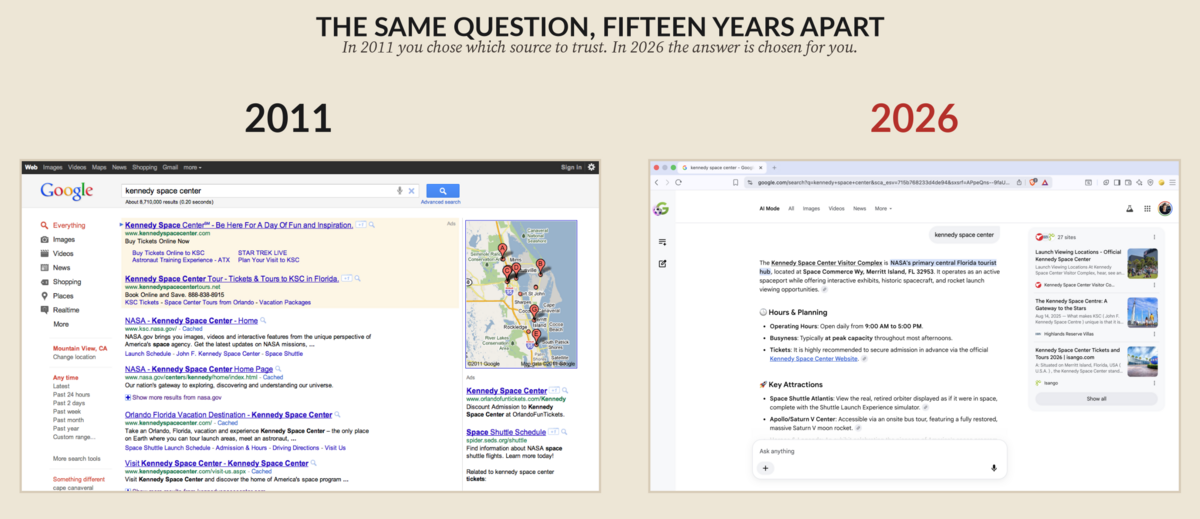
A Google search results page in 2011 (left) showed ten blue links you chose between. The same kind of query in 2026 (right) shows an AI-generated paragraph above everything else. Illustration: Sage.Education.
The experience of searching has changed, and most parents have not noticed. Years ago, a query returned a list of blue links. Ten websites, you clicked one, you read it, and you decided whether to trust it. The search engine was a librarian who pointed you to the shelf. You picked up the book yourself.
Today, that same query returns a paragraph first. A summary written by AI, placed above everything else on the page, in a box with a subtle colored border and a small label that says "AI Overview." Below the paragraph, the blue links still exist. However, most people never reach them. The paragraph in a box at the top answers their question. The paragraph is their search experience.
The Munich court understood exactly what had changed. A traditional search engine, the judge wrote, just points to other websites. It is a middleman. But AI Overviews "rewrite and judge results in their own words and according to their own structure."[10]
The search engine is no longer pointing to the shelf. It is writing its own book, in real time, and handing it to your child as if it were the truth.
The difference matters because of how children process information. An adult who has used the internet for twenty years might notice the "AI Overview" label. They might know to scroll past it. A child who has grown up with Google sees no difference between the AI box and the search results. They are all just "what Google said." And what Google said, to a child, carries the weight of authority. It is not a suggestion; it is the answer.
Where does the AI get its information? Everywhere. The Oumi study found that AI Overviews cite Facebook as their second-most-used source and Reddit as their fourth. Wrong answers cited Facebook 7% of the time. Right answers cited it 5% of the time.[11] The AI does not distinguish between a peer-reviewed medical journal and a Facebook post shared by someone's uncle. It reads everything, blends it together, and writes a paragraph that sounds like an encyclopedia.
Melanie Mitchell, a researcher at the Santa Fe Institute, has shown how badly this can go. Asked how many Muslim presidents the United States has had, AI Overviews named Barack Obama. The system had pulled a false claim off the web and repeated it as fact, missing the point of its own source.[12]
The Legal Fracture
The Munich ruling cracked open a legal question that regulators across Europe have been circling for years.
For two decades, search engines have operated under a framework that treats them as neutral go-betweens. They do not create content. They index it and they point to it. If a website publishes something false, the website is liable. The search engine is just the messenger. This framework made sense when search engines were, in fact, just messengers.
AI Overviews are not messengers.
The Munich court said so explicitly. When an AI reads ten web pages and writes a single paragraph that synthesizes, interprets, and makes new claims, it is not indexing. It is publishing. And publishers are responsible for what they publish.[13]
A spokesperson for Google told reporters it "invests deeply in the quality of AI Overviews" and that users can "dig deeper and verify" the information themselves. The Munich court rejected that defense. Telling users to check your work does not relieve you of the obligation to get it right in the first place.[14]
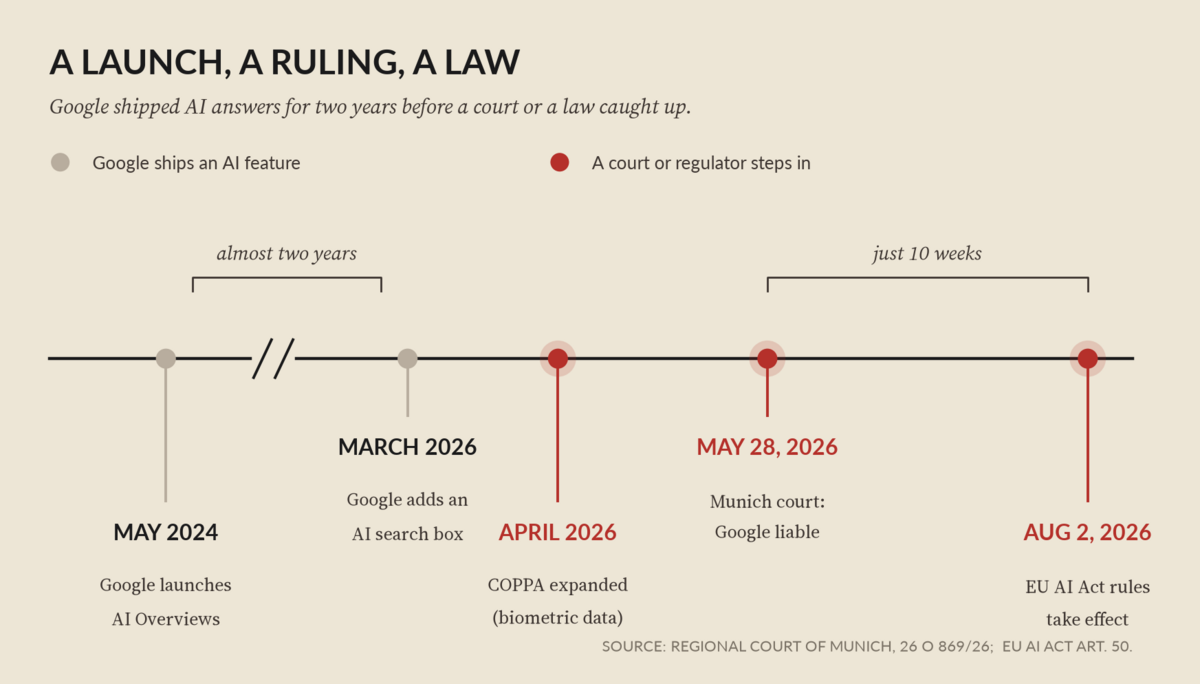
The EU AI Act's transparency rules for user-facing AI take effect August 2, 2026. The Munich ruling arrived just weeks before the regulatory landscape shifts across the continent. Illustration: Sage.Education.
The timing matters. Those EU AI Act transparency rules for user-facing AI systems take effect on August 2, 2026.[15] The UK's Competition and Markets Authority has already ordered Google to offer an AI Overviews opt-out in Britain. Across the Atlantic, no equivalent ruling exists. American schools continue to route every student query through Google Workspace, which means through AI Overviews, which means through a system that a German court has found generates false statements and presents them as facts.
Federal law has not caught up. FERPA, which protects student educational records, says nothing about the accuracy of AI-generated answers. COPPA, updated in April 2026 to include biometric data, restricts what companies can collect from children under thirteen. Neither law addresses what a company can tell a child. We have rules that protect what companies know about our children. We have no rule that protects our children from what companies tell them.
The Exit Ramp
Here is our vision: there is no single fix, but there are real steps, and they start with understanding what you are actually dealing with.
Now As a parent, you can act this week. Open your child's Google Search settings and look for "AI Overviews and more." Switch it off. Do this on every device your child uses. Check it monthly, because updates tend to reset preferences.
Better yet, change the default search engine on your child's devices. DuckDuckGo does not track searches and does not generate AI summaries above results. Startpage gives you Google's results without Google's AI Overviews or tracking – it acts as a privacy shield between your child and Google's servers. Both are free. Both take less than two minutes to set as the default in any browser.
At school, two questions will start the right conversation.
First: "Has the district evaluated the search engine students use on school devices?" Most of the time, the answer is no. Google Workspace for Education is the default in the majority of American school districts. It was adopted for email and document editing. The search engine came bundled. Nobody voted on it. Nobody reviewed its AI features. It simply arrived.
Second: "Is there a policy on AI-generated answers in school search tools?" If the answer is no (and in most districts it will be) that is the conversation that needs to happen.
Alternatives exist.
Search engines built on the principle that the tool should not track, profile, or fabricate are available today. Some are free. Some can be run on a school's own servers. The next article in this series, The Search Engine Your School Doesn't Know Exists, profiles some of these search engines in detail: what they are, what they cost, what you lose, and what you gain. There are also browsers (the software your child uses before they even type a search) that are built to protect rather than collect. The third article, Your Browser Is the First Surveillance Camera Your Child Walks Past, covers those. None of these tools are perfect. But all of them are better than a system that a court has found invents false statements and presents them as facts to anyone who asks a question.
The Box at the Top of the Page
The two publishers in Munich got their injunction. Google must stop displaying the false claims. The company must pay 80% of the legal costs. The AI Overview that called them scammers has been removed.[16]
But the system that generated those claims is the same system that generated an answer to your child's homework question tonight. The same architecture with the same 9% error rate. The same confident blue box at the top of the page.
The publishers had lawyers, they had a case number, and they had a court in Munich willing to say what needed to be said:
When an AI writes a sentence and puts a company's logo on it, the company owns that sentence, including when it is a lie.
Your child's school does not have a case number. It has a Google Workspace contract and a search engine that is no longer a search engine. It has an AI that writes its own answers in its own words and gets it wrong millions of times a day.
The publishers got their injunction. Your child has not, and that needs to change today.
Footnotes
Disclosure: This article is published by Sage.Education, a product of Startr LLC. Sage.Education builds open-source, self-hostable educational tools designed to be transparent and auditable. Startr LLC has no financial relationship with any search engine or browser mentioned in this article. The views expressed are those of the editorial board.
Landmark German ruling declares Google's AI Overviews are Google's own words, The Decoder, June 2026. ↩︎
Regional Court of Munich, Case 26 O 869/26, May 28, 2026. Reported by The Decoder and Technology.org. ↩︎
Google Will Appeal a German Ruling That Makes It Legally Liable When Its AI Overviews Lie, Tech Times, June 12, 2026. ↩︎
Google's AI Overviews Pump Out Millions Of Wrong Answers Each Hour Despite 90% 'Accuracy' Rate, Study Finds, Tech Times, April 22, 2026. Study conducted by Oumi. ↩︎
At approximately 91% accuracy across 5+ trillion annual searches, roughly 450 billion queries per year return flawed AI Overview answers, equating to tens of millions per hour. Calculation based on Oumi study figures reported by Futurism and Cybernews. ↩︎
Google AI Overviews Spread Harmful Health Misinformation, OECD AI Incident Monitor, January 2026. Guardian investigation documented incorrect advice for cancer and liver disease patients. ↩︎
Pat Pataranutaporn, MIT Media Lab, on the dangers of unflagged AI health answers. MIT Media Lab / The Guardian, February 2026. ↩︎
Reported by Cybernews and The Cooldown, citing user behavior studies on AI answer verification, 2026. ↩︎
Oumi ran the SimpleQA benchmark against AI Overviews at the request of The New York Times; the share of correct-but-"ungrounded" answers rose to more than half. Manos Koukoumidis, Oumi's chief executive, quoted in Cybernews, April 2026. ↩︎
Regional Court of Munich, Case 26 O 869/26. The court found that AI Overviews generate content by "rewriting and judging results in its own words and according to its own structure," distinguishing them from traditional search indexing. ↩︎
Oumi study, April 2026. Facebook was the second-most-cited source in AI Overviews; Reddit was fourth. Inaccurate answers cited Facebook at a higher rate (7%) than accurate answers (5%). ↩︎
Melanie Mitchell, Santa Fe Institute, on AI Overviews misreading their own sources (the "Muslim presidents" answer naming Barack Obama). MIT Technology Review. ↩︎
German Court: Google Liable for AI Summaries, GovInfoSecurity, June 2026. ↩︎
Google Will Appeal a German Ruling, Tech Times, June 12, 2026. ↩︎
EU AI Act transparency obligations for user-facing AI systems, effective August 2, 2026. GovInfoSecurity reporting on regulatory timeline. ↩︎
Regional Court of Munich, Case 26 O 869/26. Injunction granted; Google ordered to cover 80% of legal costs. Reported by The Decoder. ↩︎